
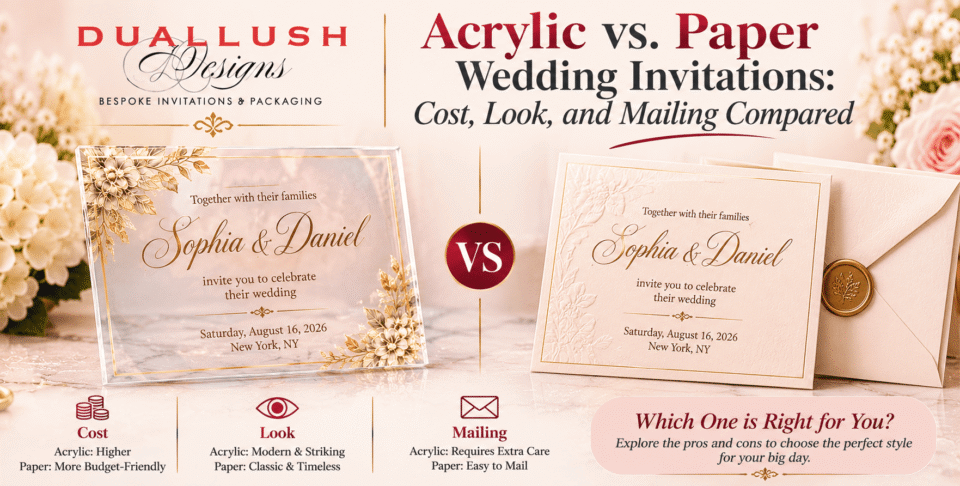
Acrylic and paper invitations look different, and most couples compare them on style first. But there’s a second comparison that only shows up at the post office: how each one actually travels. Weight, thickness, rigidity, and packaging all affect what you pay to mail an invitation, and whether it arrives looking the way it did when you sealed it.
This guide focuses on that second comparison, with worked examples, so you can budget for the mailing before you commit to a material.
A quick note on numbers: postage rates and rules change, and the figures below come from recent US postage guides. Treat them as a planning estimate, and confirm current prices with your local post office before you buy stamps.
Weight: The Biggest Difference
Weight drives postage, and this is where acrylic and paper diverge sharply. A back-of-the-envelope calculation shows the gap:
| Piece (about 5 x 7 inches) | Approximate weight |
|---|---|
| Paper card, heavyweight (about 300 gsm) | 0.25 oz |
| Acrylic card, 2 mm thick | 1.9 oz |
These estimates use typical material densities, so the real number will vary with your thickness and size. A thinner acrylic card, for example 1 mm, weighs roughly half as much. Add an envelope, a details card, and an RSVP card, and a paper suite usually lands between 1 and 2 ounces, while an acrylic suite can reach 3 ounces or more.
The takeaway: acrylic isn’t a little heavier, it’s several times heavier at the card level. The only reliable way to know your number is to weigh a fully assembled sample, envelope and inserts included.
How USPS Treats Your Invitation
For standard First-Class Mail, your invitation falls into one of three categories, and each has a different price. The tests are simple:
Is it a letter? Letters are limited in size and, importantly, in thickness. The usual limit is about a quarter inch thick, and letters have a maximum weight of 3.5 ounces.
Is it machinable? Automated sorting equipment needs a piece that’s flexible, evenly thick, and in a standard shape. Square envelopes, rigid contents, wax seals, ribbons, and lumpy embellishments can all make a piece non-machinable, which triggers a surcharge.
Is it too thick or heavy for a letter? If it exceeds the letter limits, it’s priced as a large envelope (flat) or a package, which costs more.
This is where the two materials split. Paper is flexible, so a plain rectangular paper suite usually travels as a standard machinable letter. Acrylic is rigid, so it’s likely to be treated as non-machinable, and a heavy acrylic suite can edge toward the weight or thickness limits of a letter.
Postage Examples
Recent postage guides list roughly $0.82 for the first ounce, $0.29 for each additional ounce, and a $0.49 non-machinable surcharge. Using those figures as an estimate:
| Suite | Typical weight | Approximate postage per piece |
|---|---|---|
| Paper suite, rectangular envelope | 1 to 2 oz | $0.82 to $1.11 |
| Paper suite, square envelope or wax seal | 1 to 2 oz | $1.31 to $1.60 |
| Acrylic suite, rectangular envelope | around 3 oz | about $1.89 (letter rate plus surcharge) |
| Heavy or thick acrylic suite | over 3.5 oz, or over about 1/4 inch thick | flat or package pricing, higher than the above |
Two things stand out. First, paper isn’t automatically cheap to mail: a square envelope or a wax seal adds the same surcharge. Second, acrylic suites sit close to the line where they stop being letters. If yours weighs just over the letter limit, the postage can jump, which makes weighing a finished sample before you order especially worthwhile.
A Worked Example at 100 Guests
Using the estimates above:
- Paper suite at about $1.11: roughly $111 in postage
- Acrylic suite at about $1.89: roughly $189 in postage
That’s a difference of about $78 per 100 invitations, before any extra packaging. At 150 guests it’s closer to $117. It’s not enormous, but it’s worth including in your budget alongside the invitation cost itself.
Packaging: What Each Material Needs
Paper generally needs a good envelope and, for heavier or multi-layer suites, a stiffener or flat mailer to prevent bending. Its main vulnerabilities are creased corners, moisture, and damage from sorting equipment.
Acrylic needs more deliberate protection, because it doesn’t bend, it can chip or crack, and mirror or glossy finishes scratch and show marks. Useful practices include:
- Fit matters. A snug envelope or sleeve keeps the card from sliding and knocking its own corners.
- Add a cushioning layer. A thin protective layer between the acrylic and any other cards prevents scuffs.
- Protect the surface. Mirror and glossy finishes benefit from a soft interlayer.
- Avoid overstuffing. Extra inserts can add weight and stress the envelope.
- Keep it cool. Don’t leave finished pieces in a hot car or direct summer sun.
Many of our acrylic invitations ship with a mailing envelope, and for heavier suites a sturdier mailing box provides more protection, though a box will usually price as a package rather than a letter. If your suite includes a custom invitation box, plan on package-style mailing from the start.
What Can Go Wrong in Transit
Knowing the failure points helps you prevent them:
| Issue | More common with | How to prevent it |
|---|---|---|
| Postage due or returned mail | Both, especially square, rigid, or heavy pieces | Weigh a finished sample and confirm postage at the counter |
| Chipped or cracked corners | Acrylic | Snug fit, a stiffener, and a sturdy envelope |
| Scratched or smudged surface | Acrylic (mirror, gloss) | A soft interlayer or protective sleeve |
| Creased or bent corners | Paper | A stiffener or flat mailer |
| Moisture damage | Paper | Moisture-resistant envelope or plastic sleeve |
| Broken wax seal or crushed ribbon | Both | Avoid wax or ribbon on the outer envelope |
| Illegible address on dark envelopes | Both | High-contrast lettering and a test mailing |
| Seasonal delays | Both | Avoid peak holiday mailing weeks |
The most expensive mistake is under-paying postage. Short-paid pieces can be delivered with postage due from your guest or returned to you, and under-stamped non-machinable letters are commonly returned to the sender. That’s a risk worth removing before you mail 150 pieces.
How to Test Before You Mail
A simple routine catches almost every problem:
- Assemble one complete sample, with the envelope, every insert, and any liner or sleeve.
- Weigh it on a kitchen or postal scale, to the tenth of an ounce.
- Measure its thickness at the thickest point.
- Take it to the post office and ask the clerk to price it for your zip codes, including international if you have overseas guests.
- Mail a test piece to yourself or a friend, and see how it arrives.
If the result is a surprise, you can still adjust the thickness, the envelope, or the inserts before you order the full quantity. Ordering a sample lets you run this test with your real materials.
Choosing Based on Mailing
Mailing is rarely the deciding factor, but it should be part of the decision:
- Choose paper if you’re mailing to a large guest list on a tight postage budget, or if you have many international recipients where weight adds up quickly.
- Choose acrylic if the rigid, durable format fits your style and you’ve built the extra postage and packaging into your budget.
- Mix them. Many couples use acrylic invitations for the main invitation and paper for lighter inserts, which keeps the suite’s weight under control.
- Tier your list. Send a rigid or boxed suite to your closest guests, and a lighter option to everyone else.
A Quick Checklist
- Weigh one fully assembled sample, to the tenth of an ounce
- Measure thickness, and check whether it exceeds the letter limit
- Confirm postage at the counter, and ask about non-machinable pricing
- Avoid wax seals and ribbon on the outer envelope unless you’ve priced them
- Choose a snug envelope and a protective layer for acrylic
- Mail a test piece before the full batch
- Avoid peak holiday mailing weeks
The Bottom Line
Paper is lighter, flexible, and usually cheaper to mail. Acrylic is heavier, rigid, and needs more careful packaging, but it arrives looking striking when it’s handled properly. Neither is wrong. What matters is that you price the mailing before you order, so there are no surprises at the counter.
Want help planning a suite that looks great and mails smoothly?
Get a free design consultation with our team, and we’ll help you choose the material, thickness, and packaging that fit your budget and guest list.