
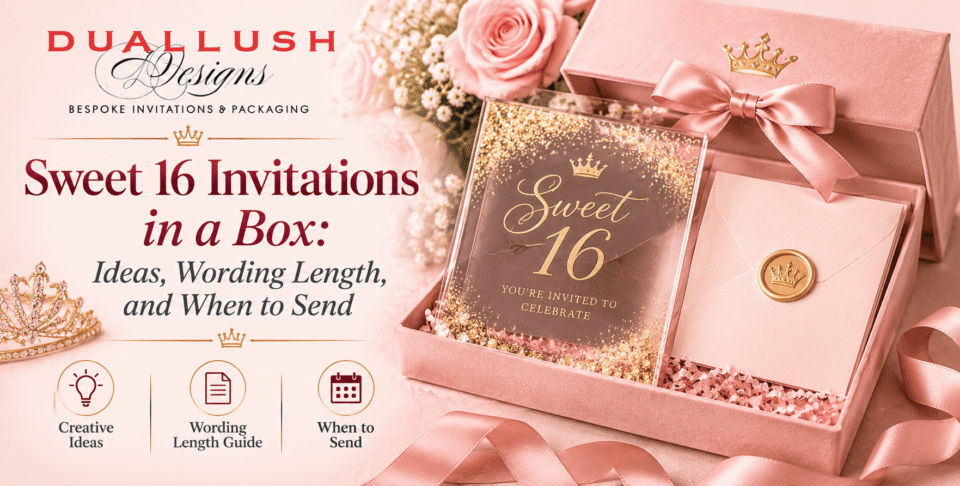
A Sweet 16 invitation has a different job than a wedding invitation. The guest of honor is turning sixteen, most of the guest list is teenagers, and the parents reading the details want clear answers fast. Put all of that in a box, and you get a piece that feels like a gift: something a teen can open, film, show off, and keep.
But a box also raises practical questions. What do you say when you have less space on each card? How much should the wording actually contain? And since boxed suites take longer to produce, when do you need to start? Here’s how to plan a boxed Sweet 16 invitation from the first idea to the mailbox.
Why a Box Works for a Sweet 16
Sweet 16s are built around shareable moments, and an unboxing is one. A box also gives you room to separate what the teen wants to see, the glamorous invitation, from what parents need to read, the logistics. A boxed suite can hold a statement invitation, a details card, and an RSVP card, each with its own job.
It’s worth being clear-eyed about the trade-offs too. Sweet 16 guest lists often run to several dozen, and a box for every guest can be a significant investment. That’s why many families use a box for a select group and a simpler invitation for everyone else, which we’ll cover below.
Boxed Sweet 16 Invitation Ideas
1. Blush Velvet Box With a Gold-Etched Acrylic Invitation
Soft pink velvet, a foil monogram, and a clear acrylic card with gold detailing is one of the most popular combinations for a glamorous Sweet 16. It’s youthful without feeling childish, and the acrylic card gives the invitation a modern, glass-like reveal. Our blush pink velvet invitation box with a custom gold foil monogram and acrylic invite has been styled as a Sweet Sixteen suite, with the honoree’s name etched into the acrylic card.
2. The Window Box
A box with a cutout window on the lid lets guests glimpse the invitation before they open it. Pair a hexagon or heart-shaped window with a soft ribbon pull tab, and the opening itself becomes part of the experience. It’s playful, photogenic, and a good fit for light colors and glitter accents.
3. Masquerade and Black-Tie
A deep-toned box in black, burgundy, or midnight blue, finished with gold foil, suits a masquerade or formal evening party. The box signals the dress code before a word is read, and a mask motif or a wax seal adds drama without extra wording.
4. Celestial and Midnight
Navy velvet paired with a mirror or silver acrylic card suits a starry or moonlit theme. The reflective surface echoes the night-sky idea, and a small celestial detail on the lid carries the theme through.
5. The Tri-Fold Folio
If a full box feels like more than you need, a folio gives you much of the same presentation in a lighter format. Our Sweet Sixteen clear acrylic invitation with foil print comes in a rose-pink tri-fold folio with a pocket for the details and RSVP cards, a good option when postage or budget is a concern.
6. Quiet Luxury
A neutral velvet box in taupe, cream, or sage, with a single foil monogram and restrained lettering, suits teens who prefer a refined look over a loud one. This style relies on material and restraint instead of decoration.
7. The Keepsake Box
Add one small personal detail inside: a note from the honoree, a printed photo strip, or a playlist code. Keep it to one item, so the box feels generous without feeling crowded.
8. The Tiered Suite
Send the boxed invitation to the honoree’s closest friends, immediate family, and honored guests, and a simpler printed or acrylic invitation to the rest of the list. This approach concentrates your budget where it has the most impact, and it’s a method we also explore in our guide to acrylic and other luxury Sweet 16 invitation materials.
How Long Should the Wording Be?
A box gives you a lot of room overall, but each individual card is still a small canvas. The most effective Sweet 16 invitations keep the main card short, and move everything else to the details card.
The main invitation: keep it brief
A useful target is a few short lines, roughly 30 to 50 words in total. It should include:
- The honoree’s preferred name
- The milestone, such as “Sweet Sixteen” or “turning 16”
- The date and start time
- The venue name
- A line about the party style or dress code, if it’s part of the theme
This keeps the card readable, especially on acrylic, where lettering needs room to breathe.
The details card: where the logistics live
Anything that doesn’t fit comfortably on the main card belongs here. That includes:
- The end time and full address
- Parking, drop-off, and pick-up information
- Who’s invited, whether parents, siblings, or plus-ones are included
- Dress code and practical advice, such as footwear
- A parent or host contact for questions
- Gift or registry preferences, if you want to include them
Because teens are the guests but parents often make the decisions, the details card is the one that answers their questions. Clear information saves you a long text thread later.
The RSVP card
Keep it simple: a name field, attend or decline, and a reply-by date. Add allergy or dietary questions if food is part of the event, and a response method that works for parents, whether that’s a reply card, a phone number, or a short web address.
Two sample directions
- Formal: “[Parents’ names] request the pleasure of your company at the Sweet Sixteen celebration of [Name]. [Day, date] at [time]. [Venue]. Formal attire.”
- Playful: “[Name] is turning 16, and you’re invited. [Date], [time], [venue]. Dress to dazzle.”
When to Send
The right timing depends on the kind of party and how firm your headcount needs to be.
| Type of Party | When to Send Invitations |
|---|---|
| Casual party at home with a flexible guest count | 4 to 6 weeks before |
| Venue, caterer, or formal event with a firm headcount | 6 to 8 weeks before |
| Destination or travel-heavy celebration | 10 to 12 weeks before |
| RSVP deadline | 2 to 3 weeks before the event |
A few reasons to send earlier than the minimum: the party falls on a busy holiday weekend, many guests are traveling, or the date overlaps with school breaks and sports seasons.
Plan Backward for a Boxed Suite
Boxed invitations take longer to produce than flat cards, so the timeline starts well before the mailing date. Work backward:
- Choose your date and set your guest count about three to four months out
- Select your box, materials, and wording, and request a quote
- Order a sample to confirm colors, finish, and layout
- Approve the final proof, then allow time for production and assembly
- Mail within your window, based on the table above
Ask your stationer for a specific production timeline for your design, since custom monograms, acrylic etching, and added inserts can extend it. Ordering a sample before your full run is the surest way to avoid last-minute surprises.
Practical Details Before You Order
- Weigh a finished suite to confirm postage, since boxes and acrylic add weight
- Order a few extras for late additions and keepsakes
- Proofread names and dates twice, ideally with the honoree
- Keep the tone consistent across the box, invitation, details card, and RSVP
- Browse our Sweet 16 invitations and invitation boxes to see how different styles handle your color palette
The Bottom Line
A boxed Sweet 16 invitation works best when each piece does one job: the box creates the moment, the main card sets the tone in a few well-chosen words, and the details card answers every practical question. Keep the wording short, start planning early enough for production, and send within the right window for your type of party.
Want help designing a boxed invitation for a Sweet 16?
Get a free design consultation with our team, and we’ll help you choose the box, materials, and timeline that fit your celebration.