
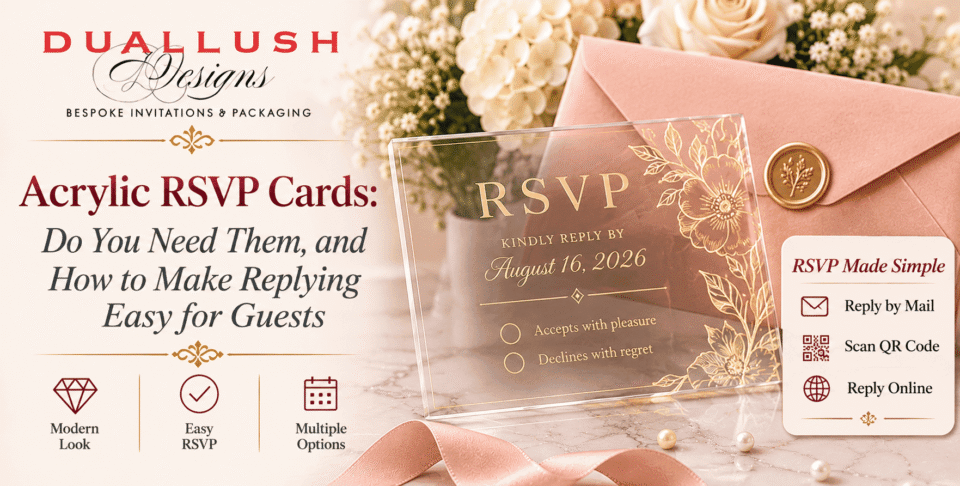
If your invitation is acrylic, it’s natural to wonder whether the RSVP card should be too. Matching materials across a suite looks cohesive, and acrylic RSVP cards are now widely sold. But an RSVP card isn’t just a design piece. It’s a tool, and its only job is to get a clear answer from your guests, quickly and without friction.
That changes the question. Instead of “should my RSVP match my invitation?”, the better one is “how will my guests actually reply?” Answer that, and the material becomes easy to choose.
The Practical Problem With Acrylic RSVPs
Traditional RSVP cards ask guests to fill in a name, tick a box, and mail it back. That works on paper, because ink soaks in and stays put. Acrylic is smooth and non-porous, so a standard pen can smear, skip, or rub off. A card that guests can’t comfortably write on isn’t doing its job.
This is why acrylic RSVP cards are usually designed around a different reply method: a QR code or website address. The card becomes a clear, elegant prompt, and guests respond online. In that setup, acrylic works well. As a write-in, mail-back card, it generally doesn’t.
Your Four Options
1. Paper RSVP Card in an Acrylic Suite
A paper RSVP card, printed on heavy stock in the same palette and typeface as your invitation, is the most practical choice for guests who prefer to write and mail. It lets you offer a traditional reply method while keeping the acrylic invitation as the centerpiece. It’s also lighter and cheaper to mail back, particularly if you include a stamped return envelope.
2. Acrylic RSVP Card With a QR Code
An acrylic card carrying a QR code and a short website address matches the invitation exactly and works well if you’re collecting replies online. Guests scan, reply, and keep the card as a keepsake. It’s a strong choice for modern, tech-comfortable guest lists, with one caveat: you need a backup for guests who won’t scan.
3. Both: Printed Card and QR Option
The most flexible approach is a paper card that offers both paths: a traditional reply line for guests who like to write, and a QR code for those who’d rather respond on their phone. This is increasingly the default for good reason. It meets every guest where they are, from a grandparent who wants a stamp to a friend who’d rather tap.
4. Website-Only
Some couples skip the physical RSVP card altogether and include a small details card with the wedding website. This reduces the number of pieces in your suite and simplifies tracking. It works best when your guest list is comfortable with online replies, and when you’re prepared to follow up with anyone who doesn’t respond.
Which Should You Choose?
| If your guests are… | Consider |
|---|---|
| Mostly older, or prefer mailing a reply | Paper RSVP card with a stamped envelope |
| Mixed ages and comfort with technology | Paper card with a QR code and website address |
| Mostly younger and tech-comfortable | Acrylic or paper card with a QR code |
| Spread across many countries | QR code or website, with a paper backup |
| Few in number and well known to you | A details card pointing to your website |
In most cases, a paper RSVP card inside an acrylic suite offers the best balance of function and cohesion. Choose acrylic for the RSVP when it’s mainly a QR prompt and the rest of your suite rewards the extra design consistency.
Making Replying Easy: What Actually Works
Whatever material you choose, the aim is the same: remove every obstacle between a guest and their reply.
Offer one obvious action. Label it clearly, such as “Scan to RSVP” or “Reply by [date].” A guest shouldn’t have to wonder what to do.
Give a firm deadline. A specific reply-by date, typically two to four weeks before the wedding, gives you time to finalize your headcount. Vague deadlines produce late replies.
Print the website address as a backup. Not every guest will scan a code, so a short, easy-to-type URL ensures nobody is stuck.
Keep the reply page simple. The page the QR code opens should work on a phone, load quickly, and take under a minute to complete. Ask only what you genuinely need: attendance, meal choice, and dietary notes.
Make who’s invited unmistakable. Name the invited guests on the envelope and, where possible, on the reply page, so there’s no confusion about plus-ones or children.
Send a gentle reminder. A short message to guests who haven’t replied, a week or so after the deadline, is far more effective than waiting.
QR Codes on Acrylic: What to Check
A QR code only works if a phone can read it. Acrylic introduces a few considerations:
- Contrast matters. Codes need strong dark-on-light contrast. A code in white ink on clear acrylic may be hard to scan, so use a solid backer or frosted surface behind it.
- Watch for glare. Mirror and glossy finishes can reflect light and interfere with scanning. Test in different lighting.
- Size it generously. Make the code large enough to scan comfortably from a normal distance, with a clear margin around it.
- Test a printed proof. Scan the code with several phones before approving the design, and confirm it opens the right page.
- Always include the URL. It’s the fallback when a scan doesn’t work.
Weight, Cost, and Mailing
A rigid acrylic RSVP card costs more to produce and weighs more than a paper one, and if you include a return envelope, guests mailing it back may face higher postage. This is another reason many couples choose a QR-based acrylic card, which doesn’t need to be mailed back at all, or a lightweight paper card when a reply by mail is expected.
If you’re assembling a suite, weigh a complete sample, with every insert, before buying postage.
Keeping the Suite Cohesive
Cohesion doesn’t require identical materials. A few approaches that tend to work:
- Print the paper RSVP in the same ink color and typeface as the acrylic invitation
- Keep a consistent palette across all pieces
- Present the pieces together in an invitation pocket or sleeve or invitation box, so the suite reads as one
- Pair a clear acrylic invitation with a paper insert in a coordinating color for contrast
If your suite pairs acrylic invitations with a velvet box, a simple paper RSVP tucked inside adds a practical layer without competing with the materials. Ask your stationer which insert materials and sizes are available for your design, and order a sample to see how everything works together.
A Quick Checklist
- Decide how guests will reply: mail, online, or both
- Use paper for any write-in reply
- Use acrylic for the RSVP only when it’s a QR or website prompt
- Add a clear deadline and a short backup URL
- Test the QR code on a printed proof, in different lighting
- Weigh a complete sample and confirm postage
- Plan a reminder for non-responders
The Bottom Line
You don’t need an acrylic RSVP card. You need an RSVP that guests can answer easily. For most acrylic suites, that means a paper reply card with a QR option, or an acrylic card used as an online prompt. Choose the method first, match the material to it, and keep the reply as simple as possible. Your guests will respond faster, and your suite will still look like one cohesive piece.
Want help choosing the right RSVP format for your suite?
Get a free design consultation with our team, and we’ll help you balance design, function, and mailing for your celebration.