
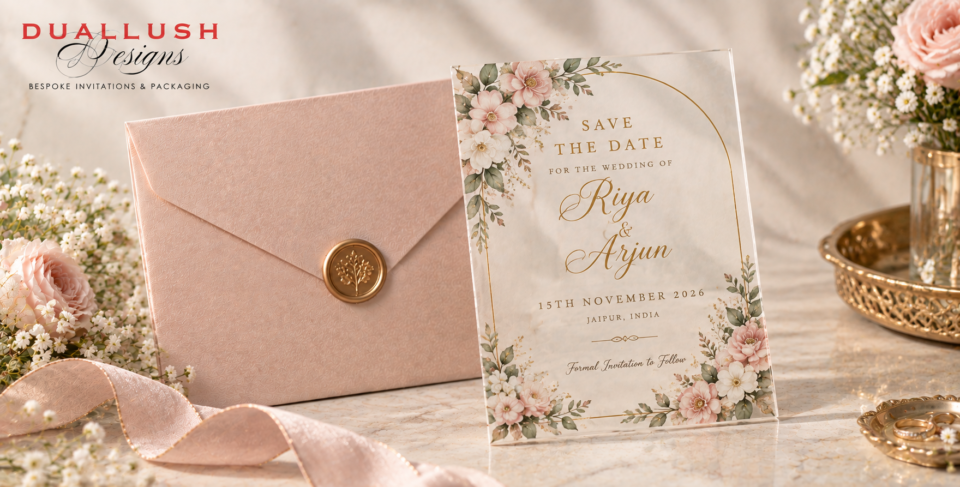
A save the date card is the first printed promise of your wedding. It arrives months before the formal invitation, asks nothing of your guests except a spot on their calendar, and quietly sets the tone for everything that follows. Because it’s small, it’s easy to treat as an afterthought. That’s a missed opportunity, and a risky one, since a wrong date or a mistimed mailing creates confusion that’s hard to undo once cards are in the mail.
Here’s a practical guide to getting all three parts right: what goes on the card, when it should arrive, and how to make it something guests keep rather than toss.
What to Include on a Save the Date
The best save the dates are deliberately short. Their purpose is clarity, not complexity, and everything else can wait for the invitation. The essentials are:
- Your names. First names are enough for most weddings; add last names for a more formal tone.
- The wedding date. This is the whole point of the card, so give it real visual weight. Match the format to your style, from a formal spelled-out date to a casual numeric one like 10.18.26.
- The location. City and state is standard. For a destination wedding, naming the venue or region helps guests start planning travel.
- “Formal invitation to follow.” A short line like this tells guests more details are coming and prevents them from wondering whether this is the actual invitation.
- Your wedding website. A URL or a small QR code lets guests find travel and accommodation information right away, especially useful for out-of-town celebrations.
What to leave off matters just as much. Skip the RSVP request, since that belongs on the formal invitation. Skip registry details, the full schedule, and dress code. A save the date that tries to do everything stops feeling like a save the date.
Who Should Receive One
Every person who gets a save the date is officially on your guest list. That means your list needs to be settled before anything goes in the mail, not after. Send them only to people you are certain you’ll invite, including a plus-one or partner where applicable, and be intentional about children: if your celebration is adults-only, address the envelope to the invited guests by name rather than to the household.
Micro weddings are one of the few cases where you might skip a formal save the date entirely, particularly if everyone on a short guest list already knows the plan.
When to Send Them
Timing depends on the kind of wedding you’re planning:
| Wedding Type | When to Send |
|---|---|
| Local wedding, most guests nearby | 6 to 8 months before |
| Wedding with many out-of-town guests | 8 to 10 months before |
| Destination wedding | 9 to 12 months before |
| Holiday weekend or peak-season date | 9 to 12 months before |
The logic is simple: flights get more expensive, hotel blocks fill up, and calendars get crowded, so the earlier your must-have guests know, the better your odds they’ll be there. You can send save the dates as soon as you’ve booked your venue and locked in a date, but don’t send them so early that guests forget, or before your guest list is final.
One practical note: matching your save the date to the rest of your stationery is a nice touch, but it’s not worth delaying your mailing timeline. If your invitation design isn’t finished yet, send the save the date on schedule and let the invitation echo it later.
Save the Date Wording That Works
Wording can be as simple or as personal as suits your style. A few directions:
- Classic and formal: “Please save the date for the wedding of [Name] and [Name]. [Date]. [City, State]. Formal invitation to follow.”
- Minimal: “[Name] + [Name]. [Date]. [City]. Invitation to follow.”
- Warm and casual: “We’re getting married! Save the date for [Date] in [City], and stay tuned for more details.”
- Playful: A short, personality-forward line that fits the two of you, kept brief enough that the date stays the star.
Whatever you choose, proofread the date, city, and spelling of every name more than once, and have someone else read it too. Typos and wrong URLs are the most common save the date mistakes, and they can mean a reprint.
How to Make Them Memorable
A save the date only needs to communicate a date, but the way it arrives determines whether it lands on a fridge or in the recycling bin. A few ways to make yours stick:
Choose a material that guests will want to keep. A tactile, premium piece signals that your wedding will be a considered, well-designed event before a single detail is revealed. An acrylic save the date is rigid, photogenic, and durable enough to sit on a desk or countertop for months, while a velvet piece gives the same first impression as a fully luxurious invitation suite. If you’re planning a layered presentation for your invitation later, a save the date in the same material sets up that moment in advance.
Let the design preview your wedding. Your save the date is the first chapter of your wedding’s visual story. Echoing your palette, a monogram, or a motif from your venue gives guests an early, accurate feeling for the celebration. This doesn’t require matching your invitation exactly, only feeling like it belongs to the same day.
Use a strong photograph, or none at all. If you include an engagement photo, let it carry the emotion and keep the wording simple around it. If you’d rather go typographic, restraint reads as confident.
Add a small interactive detail. A QR code linking to your wedding website turns a simple card into a useful tool, particularly for destination weddings where guests need travel information right away.
Consider the full suite. If your invitation will arrive in a custom invitation box or folio, planning your save the date alongside it, rather than separately, keeps the overall look cohesive and often makes ordering easier.
A Quick Pre-Mailing Checklist
Before anything goes in the mail, confirm:
- Names spelled correctly
- Date and city confirmed with your venue
- Guest list finalized and address list verified
- Website URL or QR code tested
- Postage weighed, since rigid or heavier materials like acrylic may require extra postage
- Return address included on every envelope, so undeliverable cards come back to you
The Bottom Line
A great save the date is short, accurate, and sent on time, with just enough design intention to make guests look forward to what’s coming. Get the essentials right, send them early enough for guests to plan, and choose a format that feels like a genuine preview of your wedding rather than a placeholder.
Want help designing save the dates that set up your full invitation suite?
Browse our save the date cards or get a free design consultation with our team, and we’ll help you choose the materials and design that fit your wedding.