
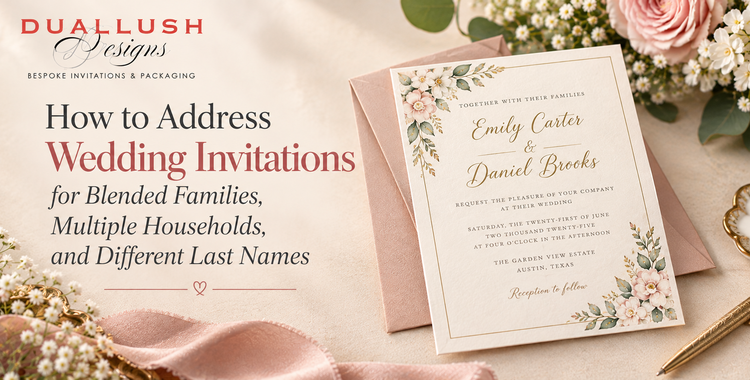
Addressing wedding envelopes sounds simple until you sit down with your guest list. Suddenly you’re asking yourself whether your stepsister’s kids share her last name, whether your friend’s invitation should go to her partner’s address or her own, and what to do about a couple who’ve never shared a surname. These situations are common, and modern etiquette has clear, kind ways to handle all of them.
The guiding principle is simple: your envelope tells a guest exactly who is invited. Get that right, and everything else is a matter of courtesy and clarity.
The Core Principle: Clarity Over Convention
Traditional rules were written for a world of households with one shared surname. Today’s families look different, and good etiquette has adapted. The goal is no longer to follow a fixed formula but to make every guest feel correctly and respectfully named, while leaving no ambiguity about who’s invited. If you’re ever unsure, the most reliable move is to ask the guest how they’d like to be addressed. A quick, friendly message while you’re collecting addresses is far better than guessing wrong.
Couples With Different Last Names
This applies to married couples where one or both kept their names, unmarried couples, and same-sex couples alike. The rule is the same: each person gets their own full name, and the envelope never assumes a shared surname.
- Place names on separate lines if they’re long, or on one line joined by “and” if they fit. Either is acceptable.
- Order is flexible. A common approach is to list whichever person you’re closer to first, or to list names alphabetically. Same-sex couples are often listed alphabetically.
- Use titles that match each person’s preference, such as Ms., Mr., Dr., or Mx. When you don’t know, a neutral approach is to use full names with no title at all.
- Never combine them into “Mr. and Mrs.” with one surname unless you’ve confirmed that’s what they use.
Unmarried couples who live together follow the same approach: both names on the envelope, each with their own full name.
Blended Families
Blended families are where addressing gets genuinely nuanced, because the people under one roof may not share names, and the household may look different depending on the day.
Children with different last names. List each child by name on the line below the parents, in age order. For children under 18, first names alone are typical, and you generally don’t need titles or last names. If last names differ across the household, writing out each child’s full name on a separate line avoids any confusion about who’s invited.
Kids invited versus not invited. The envelope is the clearest signal. If children’s names aren’t written on it, guests will understand they aren’t included. If your wedding is adults-only, address the envelope to the invited adults by name only, and mention the policy on your wedding website for extra clarity.
Stepchildren and step-siblings. Treat them as any other family member: if they’re invited, they’re named. Avoid labels like “step” on the envelope, since the envelope is about who’s coming, not how they’re related.
Adult children living at home. Guests aged 18 and over typically receive their own invitation, even if they share an address with their parents. Sending one invitation to an adult child under a parent’s name can leave them feeling like an afterthought.
Multiple Households
Some guests belong to more than one household, and the right approach depends on who’s being invited and where they actually live.
Children who split time between two homes. Send one invitation to the household where the child primarily lives, and make sure the other parent is informed of the invitation, or send a second invitation to the other household if both parents are guests. This avoids a situation where one parent assumes the child is invited and the other doesn’t know.
Divorced parents who are both invited. Each parent receives a separate invitation at their own address, rather than a single invitation to one of them. This is also a good moment to confirm each parent’s preferred name and title.
Guests with a second address. If someone splits their time between homes, ask which address to use rather than guessing. Having a clean, verified address list before you start addressing prevents returned mail and last-minute reprints.
Roommates and friends sharing an address. Each person gets their own invitation unless they’re a couple, even if they live together. Invitations are addressed to individuals or couples, not to shared addresses.
Titles, Honorifics, and Preferences
A few smaller choices matter more than they seem.
- Use full names on formal invitations rather than initials or nicknames, unless a guest only goes by a nickname.
- Honor professional titles like Dr. or The Honorable when you know they’re used, and place the more senior or more formal title first when two guests have different titles.
- Choose “Ms.” when unsure. It works for any woman regardless of marital status.
- Mind the names in the correct order. Modern practice is flexible, and the most respectful choice is the one the guest prefers.
How Boxed and Layered Suites Change Addressing
If your invitation arrives in a custom invitation box or similar layered presentation, the outer packaging carries the full mailing address, and interior pieces can use a warmer, shorter format. Many couples use first names on an inner envelope or enclosed card to keep the experience personal, while the outer packaging uses full formal names for accurate delivery. Because heavier boxed suites often need protective outer packaging, such as a mailing box, plan your addressing layout early so labels and printed names fit cleanly on the finished piece.
Build Your Address List Carefully
Most addressing problems begin before anyone picks up a pen. A reliable approach is to collect addresses and name preferences together, in one pass, using a shared spreadsheet or your wedding website. Capture each guest’s name as they want it written, their address, and whether children and plus-ones are included. If you’ve already sent save the date cards, use that mailing to verify names and addresses, since returned cards are an early warning sign of an outdated entry.
A Quick Addressing Checklist
- Each guest’s name confirmed as they prefer it
- Separate lines for guests with different last names
- Children named on the envelope only if invited
- Adult children given their own invitations
- Separate invitations for divorced parents and distinct households
- Addresses verified before printing or writing
- Return address included on every envelope
The Bottom Line
Addressing invitations for blended families, multiple households, and couples with different last names comes down to two things: clarity about who’s invited, and respect for how each guest names themselves. When in doubt, ask, and use full names wherever a single shared surname would be an assumption. Do that, and every guest will open their envelope feeling correctly and thoughtfully included.
Want help planning an invitation suite that handles your guest list gracefully?
Get a free design consultation with our team, and we’ll help you plan the pieces, packaging, and layout that make addressing straightforward.