
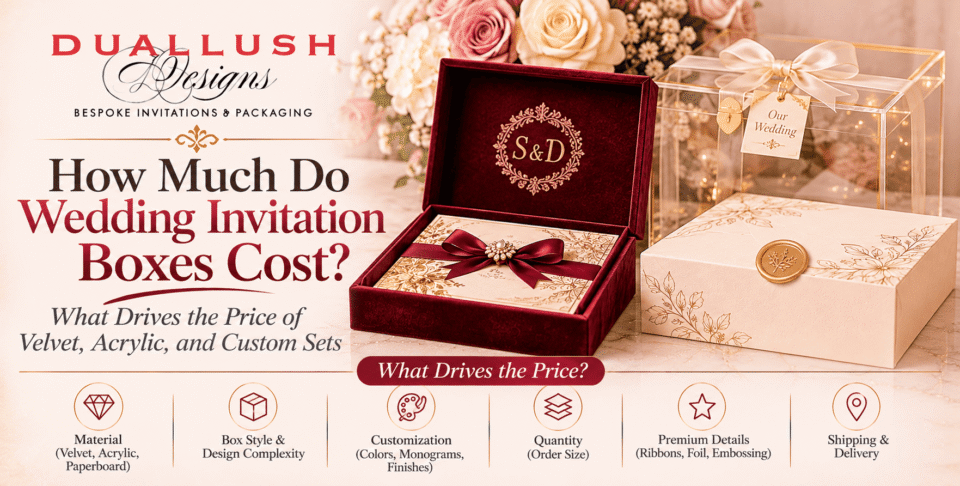
Ask three stationers for a quote on a “velvet invitation box” and you’ll get three very different numbers. That’s not because someone is overcharging. It’s because “velvet box” can mean a lightly wrapped cardboard carton or a hand-assembled rigid case with a foil monogram, a fitted insert, and a laser-cut acrylic card inside. The name is the same. The product isn’t.
This guide breaks a boxed suite into its parts, so you can see what you’re paying for, understand why quotes differ, and compare them fairly. If you want ballpark budget figures for velvet suites, our guide to velvet wedding invitation costs and budgeting tips covers that. Here we’re looking inside the price.
Two Kinds of Cost Behind Every Quote
Every custom invitation has costs of two types, and understanding the difference explains most of what you see on a quote.
Fixed costs are the same whether you order 50 pieces or 200. These include design and proofing, die creation for foil stamping, laser-cutting setup, and file preparation. Spread across a small order, they inflate the price of each piece. Spread across a large order, they shrink.
Per-piece costs grow with quantity. These include materials, fabric, board, acrylic, inserts, printing, assembly time, and packaging.
This is why price per piece falls as your quantity rises, and why many studios set minimum orders, often starting around 25 to 50 pieces. It’s also why a very small run can feel expensive per invitation: you’re paying a share of setup that doesn’t shrink with quantity.
What You’re Paying For in a Velvet Box
A velvet box looks like one item. In production, it’s several.
The rigid shell. Quality boxes start with a thick, dense board core, shaped and glued into a structure that holds its form. Thicker board, tighter construction, and a hinged lid all add material and labor. This is the biggest difference between a box that feels substantial and one that feels flimsy.
The wrap. Velvet or suede is cut, applied, and finished by hand, with edges and corners neatly turned. The grade of fabric affects both look and cost: denser, more even velvet costs more than a thin or synthetic alternative.
The interior. Lining, fitted trays, and pockets protect the contents and organize the unboxing. A simple open interior costs less than a fitted layout with compartments for several cards.
The closure. A ribbon tie, magnetic snap, or tassel is each a separate component with its own materials and assembly.
Foil stamping or embossing. A foil monogram requires a custom die, which is a one-time setup cost, plus per-piece stamping. Larger or multi-color designs cost more. Market guides commonly cite foil stamping with a custom die as one of the larger line items on a stationery order.
Embellishments. Tassels, brooches, ribbons, and wax seals each add material and hand labor. Individually small, they can add up across a full guest list.
Interior illustration. A custom venue illustration or printed lid interior adds design time and printing.
Hand assembly. Many boxed suites are assembled by hand, and that labor is a real part of the price.
What You’re Paying For in an Acrylic Invitation
An acrylic card is simpler in structure but has its own cost levers.
Thickness. Acrylic invitations are commonly 1 mm to 3 mm thick. Thicker panels feel more substantial and resist chipping, but they cost more and weigh more, which also affects postage.
Size and shape. A larger panel uses more material, and a custom shape requires laser cutting, which adds setup and machine time. Intricate cut patterns take longer than clean rectangles.
Finish. Clear is the baseline. Frosted, mirror, and colored finishes involve additional processing and materials, and mirror finishes tend toward the higher end.
Print method. Acrylic needs specialized printing, such as UV printing, screen printing, or foil, rather than ordinary press printing. This specialization is one reason acrylic costs more than paper.
Engraving and detail. Etched or engraved lettering and fine detail add machine time.
Protective handling. Individually wrapping each panel to prevent scratches and chipping adds cost, especially for mirror finishes.
What Makes a Set “Custom”
A set multiplies everything above, and then adds more.
- Number of pieces. Each additional card, such as an RSVP, details card, or accommodations card, is another unit to print, cut, and assemble.
- Level of personalization. A monogram, a venue illustration, and custom wording each add design time.
- Design and proof rounds. Some studios include a set number of revisions, while others charge for extra rounds or for design work beyond a template.
- Packaging. A rigid mailer or presentation box is often a separate line item. One industry guide notes that boxed acrylic sets can add several dollars per invitation in packaging alone.
- Assembly. Hand-placing cards, ribbons, and inserts takes time, and some studios charge for it separately.
Why Published Prices Disagree So Much
If you’ve researched online, you’ve probably seen wildly different figures for the same material. For example, published guides put acrylic invitations anywhere from under $5 per card to $25 or more. Both can be accurate, because they describe different products: a thin, small, simple panel versus a thick, large, custom-cut, mirror-finish one with an envelope and inserts.
The lesson: a price is only meaningful alongside its specification. When you compare quotes, compare the spec first.
Costs That Often Sit Outside the Quote
A line-item quote may not include everything you’ll spend. Ask about:
- Samples. Some studios charge for samples, with or without credit toward your order.
- Shipping to you. Heavy boxes cost more to ship, and international orders may involve customs charges and taxes.
- Postage to your guests. Rigid and boxed suites weigh more and may be priced differently from standard letters, so weigh a finished sample before you budget.
- Outer packaging. A protective mailer or shipping box is often extra.
- Extras. A 10 to 15 percent buffer for spares is wise, since reprints usually cost more per piece than the original run.
- Addressing. Printed or hand-lettered addressing is a separate cost.
How to Compare Quotes Fairly
Use this checklist to put quotes on equal footing. Ask each studio the same questions:
| Ask about | Why it matters |
|---|---|
| Box construction and board thickness | A thicker, rigid build costs more and lasts longer |
| Fabric type and grade | Velvet and suede vary widely in quality |
| Acrylic thickness, size, and finish | Drives both price and weight |
| Number and type of inserts | Cards, pockets, and trays add up |
| Personalization included | Monogram, foil, illustration, and wording |
| Setup and die fees | Often one-time and separate |
| Number of proof rounds included | Extra rounds may cost more |
| Assembly included or extra | Hand assembly is real labor |
| Outer mailing packaging | Often not included |
| Minimum order and price breaks | Small differences in quantity can change the rate |
| Production time and rush fees | Compressed timelines can add cost |
| Sample policy | Costs and credit vary |
Write the answers in a simple table, one column per studio. A quote that looks cheaper often turns out to leave out inserts, assembly, or packaging.
Making Sure You Can See What You’re Paying For
The most reliable way to judge value is to hold the product. Ordering a sample lets you check the feel of the fabric, the thickness of the acrylic, and the fit of the interior against your expectations. Browse our velvet invitations, acrylic invitations, and wedding invitation boxes to see how different specifications look at different levels of detail.
The Bottom Line
A boxed suite is priced by its parts: the shell, the fabric, the interior, the acrylic, the foil, the inserts, the assembly, and the packaging. When quotes differ, it’s almost always because the specifications differ. Ask every studio the same questions, compare line by line, and remember to budget for the costs that sit outside the quote.
Want a quote built around your guest count and design?
Get a free design consultation with our team, and we’ll walk through the options, specifications, and price drivers so you know exactly what you’re paying for.