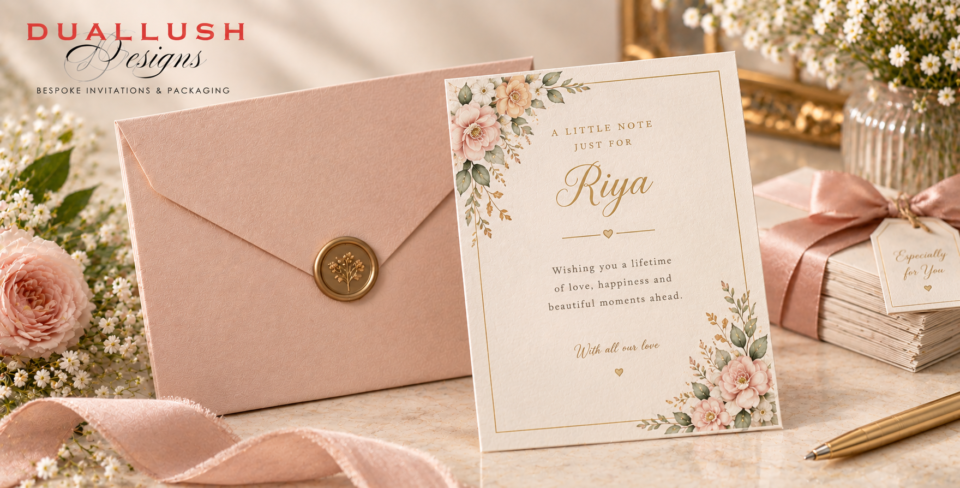
A generic card used to be an acceptable default. In 2026, it increasingly reads as an oversight. Across weddings, birthdays, baby showers, and coming-of-age celebrations alike, personalized stationery has moved from a special-occasion upgrade to something closer to a baseline expectation, and the shift is happening for reasons that go well beyond aesthetics.
From “Nice Extra” to Default Expectation
For years, personalization meant swapping a name and date into an otherwise generic template. That’s no longer what the word signals. Across nearly every celebration category, hosts and honorees are now expected to build a small stationery system around their specific event, one that carries a consistent monogram, color story, or motif across every printed piece rather than treating each card as a standalone purchase. The overarching shift across the industry is best described as customization without compromise: couples and hosts increasingly want the full personalization of a bespoke piece without settling for a design that looks obviously templated.
Why This Shift Is Happening Now
A few forces are converging at once:
Templates got too easy to access to feel special. As design tools have made semi-custom stationery faster and cheaper to produce, the visual gap between a nicely chosen template and a genuinely custom piece has narrowed on the surface, which paradoxically makes real personalization more valuable as a signal of effort and intention.
Celebrations are being treated as complete visual experiences, not single events. Rather than a single invitation, hosts are increasingly building coordinated systems: invitations, response cards, and thank-you notes that all share one visual identity. A card that doesn’t match the rest of the system now reads as an inconsistency rather than a standalone piece.
Multicultural and blended celebrations want accurate representation. As American celebrations increasingly reflect multiple cultural traditions within one family, generic templates, built to apply broadly, often can’t represent both sides of a family’s story in one cohesive design. Multi-event celebrations common in South Asian, Jewish, and Nigerian traditions, for example, need coordinated stationery across several distinct events, which is difficult to achieve with disconnected template pieces.
Print itself has become a deliberate, tactile choice. In a year defined by “quiet luxury” and a return to physical, sensory experiences, stationery that rewards a closer look, a sculptural emboss, a foil detail, a considered layout, feels more valuable precisely because so much of everyday communication has moved to a screen.
Where Personalization Shows Up Across Celebration Types
Weddings
Custom monograms, venue illustrations, and cultural motifs woven into a couple’s specific story remain the clearest example of this shift, and increasingly extend well past the invitation itself into save the date cards, place cards, and other day-of stationery built around the same visual system.
Sweet 16s and Coming-of-Age Celebrations
Personalization here is less about family heritage and more about individual identity. A Sweet 16 invitation built around the honoree’s actual aesthetic, glamorous, celestial, minimalist, whatever fits her specifically, reads as far more considered than a generic party template, even at a similar price point.
Bar and Bat Mitzvahs
Personalization takes on real cultural weight here. A family’s decision about how much Hebrew text, religious imagery, or family tradition to include is itself a form of personalization, distinct from purely aesthetic customization, and one that generic templates are rarely built to accommodate well.
Baby Showers
Personalized stationery for a baby shower increasingly reflects the specific theme and tone chosen for the event rather than a generic “congratulations” card, and can extend to a custom invitation pocket or box for showers meant to feel more elevated than casual.
Birthdays at Every Age
From a first birthday’s soft, family-facing design to a milestone 50th’s more refined presentation, the expectation across the full age range is the same: an invitation that matches the actual person and occasion being celebrated, not a stock “birthday party” design applied regardless of who’s turning what age.
The Techniques Making This Possible
A few production choices are doing much of the work behind this shift:
- Custom monograms and crests, designed specifically for the person or couple rather than pulled from a font library, that can carry consistently across every piece in a stationery system
- Foil stamping and embossing, increasingly accessible outside strictly high-budget celebrations, adding a tactile, dimensional quality that flat printing can’t replicate
- Custom illustration, whether a venue rendering, a family motif, or a design tied to a specific shared interest
- Material choice itself as personalization, since velvet, acrylic, or a specialty finish communicates a specific aesthetic decision that standard cardstock simply can’t
What This Means If You’re Planning a Celebration
The practical takeaway isn’t that every card in a celebration needs an elaborate custom illustration. It’s that consistency and specificity now matter more than they used to. A single meaningful detail, a monogram, a color drawn from something personal, a material that fits the occasion’s tone, carried consistently across every piece, reads as far more custom than an invitation with a busy design but no connection to anything else in the suite.
If you’re deciding where to invest personalization effort, start with the piece every guest sees first, then extend that same detail outward rather than personalizing each piece independently.
Want help building a personalized stationery system for your celebration?
Get a free design consultation with our team, and we’ll help you carry one meaningful detail across your entire suite, whatever you’re celebrating.