
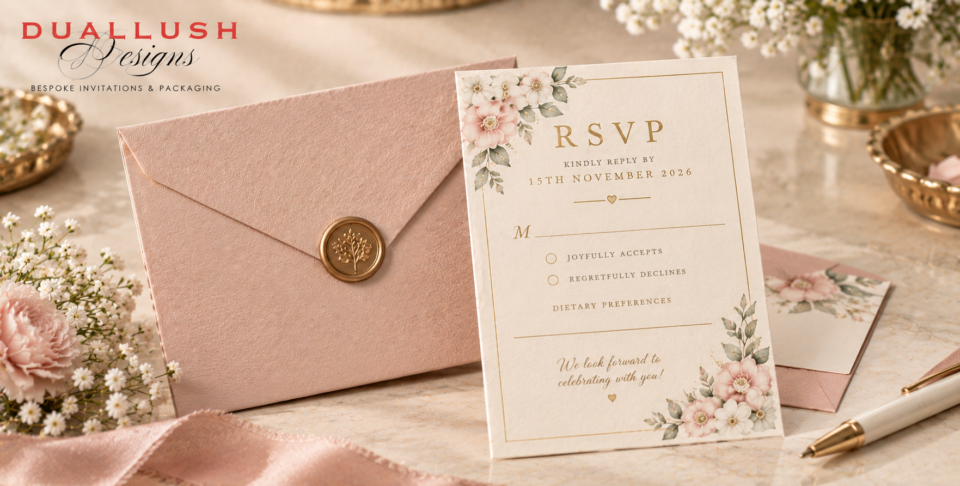
An RSVP card looks like the smallest piece of a wedding invitation suite, and it’s also the one doing the most practical work. It tells you exactly how many people are coming, what they’ll eat, and whether you need to chase anyone down before your final headcount is due. Get the wording and logistics right, and replies come back on time with no confusion. Get it wrong, and you’re calling guests the week before your wedding to figure out who’s actually showing up. Here’s everything to know before you print yours.
Why RSVP Cards Are Separate From the Invitation
It can seem simpler to just print “please respond by [date]” on the invitation itself, but tradition and practicality both argue against it. Etiquette has long considered it a little presumptuous to put response instructions on the same card that extends the invitation. More practically, a separate card gives guests a dedicated, obvious place to write their name and response, and gives you a physical object to sort and tally as replies come in.
The Essential Elements Every RSVP Card Needs
Strip away the optional extras, and every RSVP card really only needs four things:
- A response line. Traditional cards use “Accepts with pleasure” and “Declines with regrets,” or the shorter M-line convention (an underscored “M” followed by a blank, where guests fill in Mr., Mrs., or Ms. and their name). Modern cards often simplify this to “Will attend” and “Unable to attend,” or a checkbox for each option.
- A name field. Include only the invited guest’s name, without “and guest” or extra blank space, since that space is exactly how uninvited plus-ones show up on your final count.
- A response deadline. Two to four weeks before the wedding is standard, timed so you can hand a final number to your caterer and venue comfortably in advance.
- A way to respond. A pre-stamped, pre-addressed return envelope for mailed cards, or a clear QR code or short URL if you’re collecting replies online.
Everything past this point is optional, and should only be added if you genuinely need the information.
Optional Additions Worth Considering
Meal choice. If your caterer requires selections in advance, keep the wording short: “Chicken” or “Beef” is usually enough, with a fuller description reserved for your wedding website rather than the card itself.
Dietary restrictions. A short line (“Dietary restrictions: ___”) lets guests flag allergies or preferences without you needing to track every guest down individually.
Song requests. Increasingly common on both printed and digital RSVP cards, this is a small, low-stakes way to get guests invested before the big day.
Adults-only or kids-welcome notes. If your wedding has a policy either way, a brief line here (or addressing envelopes without children’s names) heads off confusion before it starts.
What to leave off: full menu descriptions, registry information, and anything not directly tied to collecting a response. An RSVP card that tries to do too much stops being quick to fill out, which is exactly what discourages guests from responding on time.
Printed vs. Digital: Do You Need Both?
More couples in 2026 are collecting RSVPs digitally, either exclusively or alongside a printed card, and it’s worth understanding why both formats still have a place. Printed cards work reliably for every guest regardless of their comfort with technology, and they remain part of the physical keepsake of your invitation suite. Digital RSVPs, collected through a wedding website or QR code, are faster to tally and easier to update in real time, particularly useful for guest lists with a lot of last-minute changes.
Many suites now use a hybrid approach: a small printed card in the envelope with a QR code and brief instructions, rather than a full traditional reply card with its own return envelope. This cuts printing and postage cost while still giving guests a physical prompt to respond.
Matching Your RSVP Card to Your Invitation
Your RSVP card is not a standalone piece. It should share the same design language as your primary invitation, meaning the same paper stock or material, typography, and color palette, so nothing in the suite reads as an afterthought. If your main invitation uses velvet or acrylic, a coordinating RSVP card in the same material keeps that consistency intact rather than reverting to plain cardstock partway through the suite. If your suite is presented in a custom invitation box or a folio, your RSVP card is one of the pieces guests will see arranged inside, so its finish should hold up to that same presentation.
Common Mistakes to Avoid
- Leaving off the deadline entirely, or setting one so close to the wedding that you have no buffer to follow up with stragglers.
- Asking guests to write their own headcount without a clear number field, which invites confusion about whether a plus-one is included.
- Mismatched wording tone between the invitation and the RSVP card, such as a formal invitation paired with a casual reply card. Consistency across the suite matters more than any individual line of wording.
- Forgetting return postage on a mailed card, which quietly lowers your response rate since guests have to find their own stamp.
- Overloading the card with menu descriptions, registry mentions, or event details that belong elsewhere in the suite or on your wedding website.
A Simple Timeline
- Design and order your RSVP cards alongside the rest of your suite, so materials and finishes match without a second production run.
- Mail with your invitations, 8 to 12 weeks before the wedding depending on how many out-of-town guests you’re inviting.
- Set your deadline 2 to 4 weeks before the wedding, giving yourself time to finalize numbers with your caterer and venue.
- Follow up directly with any guest who hasn’t responded by about a week after your deadline, rather than waiting indefinitely.
The Bottom Line
An RSVP card only needs to do a few things well: ask clearly, give guests an easy way to answer, and match the rest of your suite. Keep the wording simple, only add the optional fields you genuinely need, and set a deadline with enough room to actually finalize your numbers. Get those fundamentals right, and the rest of the wording is really just a matter of matching your wedding’s tone.
Want an RSVP card designed to match your full invitation suite?
Get a free design consultation with our team, and we’ll help you choose the wording, material, and finish that keep your whole suite cohesive.