
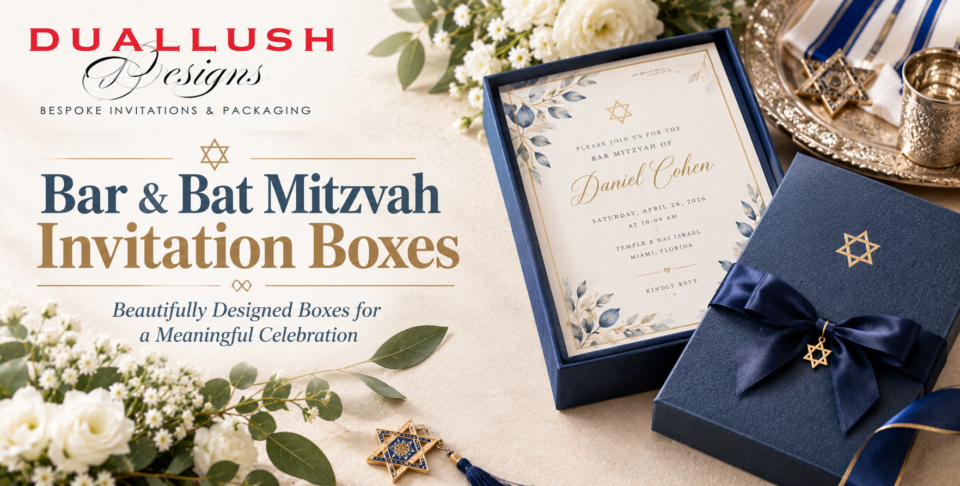
A boxed invitation turns a Bar or Bat Mitzvah announcement into something guests keep. It’s also a bigger production than a single card, which means two questions come up quickly: what actually goes inside the box, and how early do you need to start?
Both answers depend on the particular shape of a Bar or Bat Mitzvah. The service and the celebration are often separate events with separate guest lists, the ceremony is typically open to the whole congregation, and your timeline can shift with the Jewish calendar, school schedules, and summer travel. Here’s how to plan a boxed suite that handles all of it clearly.
Why a Box, and When It Makes Sense
A box gives you room to separate the ceremony information from the party information, which is exactly what many families need. It also suits the significance of the occasion: a milestone that took years of preparation deserves a presentation that feels ceremonial.
A boxed suite tends to be a good fit when:
- The service and celebration are at different locations or times
- Guests are traveling and need accommodations and directions
- You want a keepsake for close family and friends
- The celebration is formal or on a larger scale
It’s less necessary for a casual kiddush luncheon or a small family gathering, where a single well-designed card is plenty.
You can also tier your suite. Many families send a boxed version to grandparents, close relatives, and honored guests, and a simpler invitation to the wider list. It’s entirely acceptable, and it concentrates your budget where the personal significance is greatest.
What Goes Inside the Box
The Main Invitation
This is the centerpiece, and it should carry the essentials of the occasion:
- The honoree’s name, typically first and middle name, without a title, since the honoree is under 18
- The wording that marks it as a Bar or Bat Mitzvah, such as being called to the Torah
- The host names, usually the parents, and grandparents if they’re hosting
- The date, including the day of the week, the time, and the name and address of the synagogue or venue
Many families include the Hebrew name as well. Some congregations have a preferred style, so it’s worth checking with your synagogue before the design is finalized.
The Reception or Party Card
Because the service is generally open to the congregation, while the celebration afterward is by invitation, it’s common to leave the party details off the main invitation and put them on a separate insert for guests invited to the celebration. This is one of the clearest advantages of a boxed suite: the main invitation can stay focused on the ceremony, while a reception card holds the details for the party.
The reception card should include:
- The venue, address, and start time
- Whether it’s a kiddush luncheon, an evening party, or both
- The dress code
- A note on whether children are invited
The RSVP Card
The RSVP is typically requested for the celebration rather than the service. Set the reply-by date three to four weeks before the event, and make it easy to complete: a name field, a response line, a place for meal choices if relevant, and a pre-addressed return envelope or QR code.
The Accommodations Card
For out-of-town guests, this is often the most useful insert. Include hotel names, any group rate, the booking deadline, and how to reserve. If your service falls on Shabbat and some guests observe it, note which hotels are within walking distance of the synagogue. It’s a small detail that makes a real difference for observant guests.
The Directions or Details Card
Parking, transportation between venues, and a map are helpful when the ceremony and celebration are in different places. A short, clear card avoids a flood of last-minute questions.
Optional Keepsake Details
A box can hold a personal note from the honoree, a small keepsake tied to the theme, or a monogram in the honoree’s chosen colors. Keep these small and meaningful, so the box feels generous without feeling crowded.
Match the Box to the Celebration
The presentation should fit the tone of the event, not just the milestone.
- Formal, evening celebrations suit rich colors, foil monograms, and mirror or velvet finishes.
- Modern, personality-driven celebrations suit sleek acrylic, bold colors, and laser-cut details. Our Bar and Bat Mitzvah invitations include clear, glitter, and mirror acrylic designs that can be paired with additional inserts such as reception, accommodations, details, and directions cards.
- Traditional celebrations often lean on classic colors, Hebrew lettering, and symbols that reflect the family’s relationship to the tradition.
If you like the look of a clear acrylic invitation, such as our clear acrylic Bat Mitzvah invitation, you can pair it with a box or folio presentation for a layered result. You can also explore velvet invitations and our broader invitation boxes to see how different presentations handle your palette.
When to Send: A Timeline
Timing guidance from stationers and planners converges on a consistent pattern, with a few seasonal adjustments.
| Milestone | Typical Timing |
|---|---|
| Save-the-date | 6 to 12 months before, especially for out-of-town guests |
| Mail invitations | 6 to 8 weeks before as a general guide, up to 10 weeks for busy seasons |
| Early fall dates | 10 to 12 weeks before, since summer travel and camp schedules spread guests out |
| RSVP deadline | 3 to 4 weeks before the event |
| Follow up with non-responders | Within a week after the RSVP deadline |
A few things shift the calendar:
- Fall celebrations. If your event falls in September or early October, many guests are away during the summer. Mailing earlier, with a longer response window, gives you better results.
- Holiday or school-break dates. If your date is close to a holiday or a school vacation, add a week or two of lead time.
- Summer travel. If many guests will be away, consider an RSVP date more than a month before the event so you have time to follow up.
Plan Backward for a Boxed Suite
A boxed suite has more components than a flat invitation, so production takes longer. Plan backward from your mailing date:
- Decide your date and send save-the-dates 6 to 12 months out
- Finalize your guest list and wording early, including the Hebrew name if you’re using one
- Begin your design and request quotes roughly four to five months before the event, to leave room for proofing
- Order a sample to confirm colors, finishes, and layout
- Approve the final proof and allow time for production and assembly
- Mail on schedule, based on your seasonal timeline
Ask your stationer for a specific production timeline for your design, since custom materials and added inserts can extend it. Ordering a sample before your full run is one of the best ways to avoid last-minute surprises.
A Few Practical Details
- Weigh a finished suite to confirm postage, since boxes and acrylic add weight.
- Order extras. A handful of additional suites covers late additions and keepsakes.
- Proofread Hebrew text carefully, ideally with someone who reads Hebrew.
- Keep the tone consistent across the invitation, reception card, and RSVP so the suite reads as one piece.
- Set up a simple event page to hold anything likely to change, such as parking updates or schedule tweaks.
The Bottom Line
A boxed Bar or Bat Mitzvah invitation works best when each piece has a clear purpose: the main invitation honors the occasion, the reception card handles the party, and the supporting cards help guests arrive on time and informed. Start planning early, send within the right window for your season, and let the presentation reflect both the significance of the day and the personality of the honoree.
Want help designing a boxed suite for your child’s Bar or Bat Mitzvah?
Get a free design consultation with our team, and we’ll help you choose the materials, inserts, and timeline that fit your celebration.