
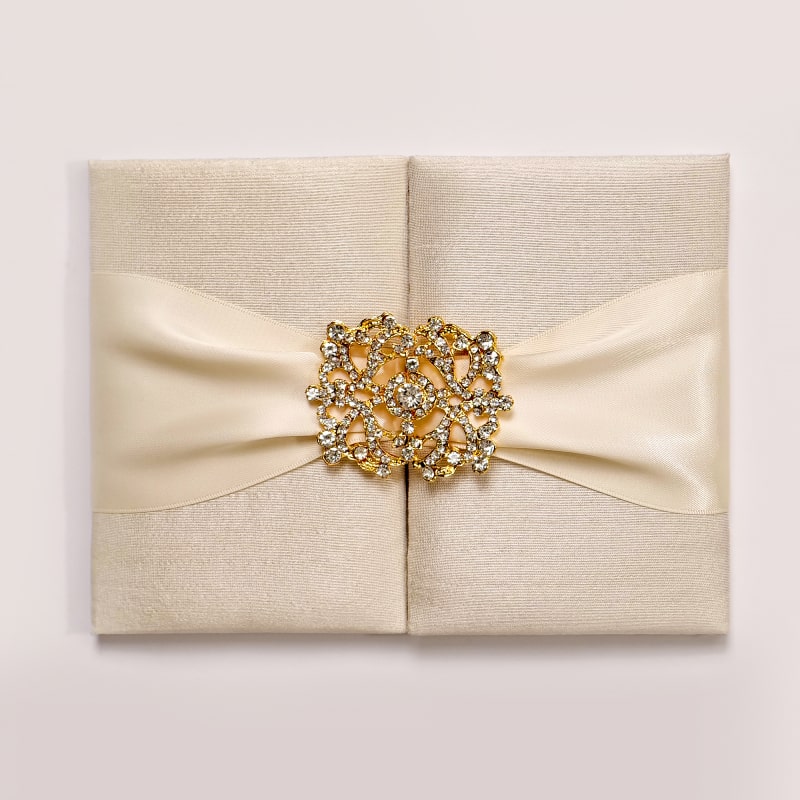
If you’ve been scrolling wedding inspiration lately, you’ve probably noticed a format showing up again and again: an invitation that opens like a small book or envelope, revealing layered cards, ribbon, and inserts arranged neatly inside rather than a single flat card. That’s a folio invitation, and it’s become one of the most requested formats in luxury wedding stationery this year. Here’s what it actually is, why it’s resonating so strongly right now, and how to know if it’s right for your wedding.
What Is a Folio Invitation, Exactly?
A folio invitation is a wraparound cover typically fabric, leather, or heavy cardstock that opens to hold your full invitation suite inside, rather than sending each piece (invitation, RSVP card, details card) as loose, separate pieces in an envelope. Think of it less as a single card and more as a small presentation case: the folio itself becomes part of the design, not just packaging around it.
The word “folio” comes from bookbinding, and that lineage matters a well-made folio invitation genuinely feels closer to a small book or keepsake object than a piece of mail, which is exactly the effect couples are chasing.
Why Folios Are Having a Real Moment
A few things are converging to push folio invitations to the top of 2026 wish lists:
Wedding stationery is being treated as an experience, not a document. Across the luxury market this year, invitations are increasingly designed to be touched, opened, and lingered over not just read and set aside. A folio delivers that naturally, since guests have to physically open it to see everything inside, creating a small built-in moment of discovery.
Layering is the defining visual language of 2026. Vellum overlays, ribbon closures, tiered inserts, and mixed materials are dominating luxury stationery trend reports this year, and a folio is essentially the format built specifically to hold that kind of layered composition together in one cohesive piece, rather than risking loose cards shifting around inside an envelope.
It solves a real practical problem. Multi-piece suites invitation, RSVP card, details card, sometimes a map or accommodations card can feel disorganized as separate loose pieces. A folio keeps everything contained, ordered, and presented the way it was actually designed to be seen.
What’s Inside a Typical Folio Suite
While every design is different, most folio invitations are built around a similar internal structure:
- The cover the folio itself, in fabric, leather, or heavyweight cardstock, often finished with foil, embossing, or a monogram
- The main invitation card, positioned as the first thing a guest sees when the folio opens
- A pocket or slot holding the RSVP card, details card, and any additional inserts
- A ribbon, wax seal, or belt closure keeping the folio shut during mailing
The best folio designs treat the interior arrangement with as much care as the cover cards are meant to sit in a specific, considered order, not just be stuffed inside.
Folio Materials Worth Knowing
Silk folios are the most requested option for couples wanting a soft, luxurious texture without the weight or cost of velvet. A silk folio has a subtle sheen and drape that photographs beautifully and feels distinctly elevated in hand it’s become particularly popular for destination and luxury celebrations where the unboxing moment matters as much as the design itself.
Velvet folios bring the same plush, jewel-toned richness that’s driving so much of 2026’s broader stationery trends. A velvet cover suits romantic, traditional, or cultural weddings especially well, and pairs naturally with foil-stamped monogram detailing on the cover.
Leather folios lean more structured and modern, appealing to couples who want the folio format’s organization without a soft, fabric-forward aesthetic a strong fit for editorial or contemporary weddings.
Folio vs. Boxed Invitations: What’s the Difference?
Folios and boxed invitations are often mentioned in the same breath, but they’re genuinely different formats. A boxed invitation is a rigid, lidded container closer to a small gift box while a folio is a flatter, book-like wrap that opens rather than lifts. Folios tend to be lighter and less expensive to mail, since they don’t require the same rigid structure or protective packaging a box does, while invitation boxes generally create a slightly more dramatic, gift-like unboxing moment. Some couples choose one or the other; some combine both, nesting a folio inside a box for the fullest layered presentation.
Is a Folio Invitation Right for Your Wedding?
Folios tend to work especially well for:
- Multi-piece suites with several inserts that need to stay organized and presentable
- Destination weddings, where a slim, protected folio travels more easily than a bulky rigid box
- Couples who want a “keepsake” quality without going as maximalist (or as costly) as a fully boxed suite
- Formal and cultural celebrations, where a folio’s structured presentation feels appropriately ceremonial
They’re a less natural fit for very casual or minimalist weddings, where a single elegant flat card might communicate the right tone more efficiently than a multi-piece format.
Getting Started With a Folio Suite
Because a folio holds multiple components, it’s worth planning the full suite together from the start cover material, insert layout, and closure detail rather than designing the cover first and figuring out the interior later. Color, weight, and texture all read differently in person than on a screen, so ordering a sample before committing to your full print run is the best way to see how your chosen material actually feels in hand.
The Bottom Line
A folio invitation isn’t just a trend for the sake of being trendy it solves a real design problem (keeping a multi-piece suite organized) while delivering exactly the kind of tactile, considered experience 2026’s luxury couples are drawn to. If your suite has more than one or two pieces and you want guests to genuinely feel the care behind it, a folio is worth serious consideration.
Curious whether a folio suits your wedding suite? Get a free design consultation with our team, and we’ll help you choose the material, layout, and closure that fits your celebration.
