
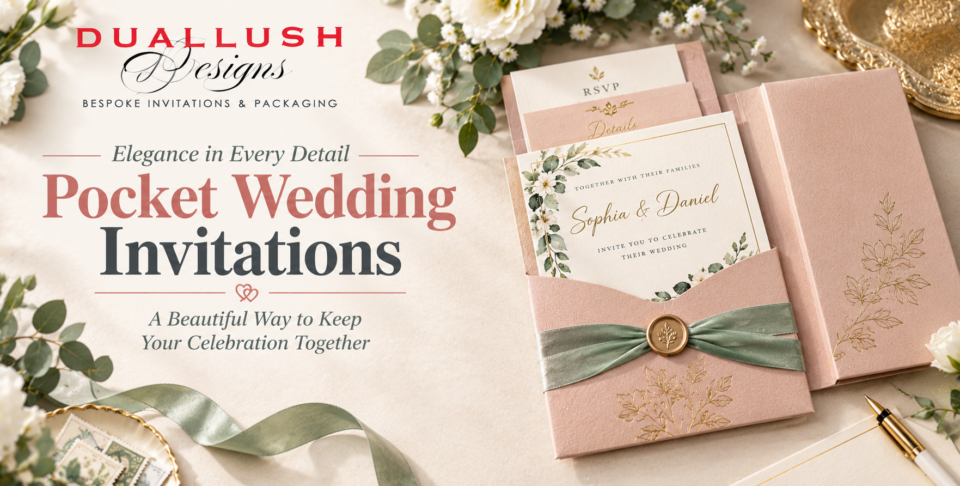
A pocket invitation solves a real problem: it keeps a multi-piece suite organized and presentable. But it creates a new question the moment you start designing one. You have a pocket, or two, and a list of things guests might need to know. What actually goes in there, and where?
Getting this right matters more than it seems. A pocket stuffed with every possible card feels like homework. A pocket missing the one thing guests need leaves them emailing you for the address. Here’s how to decide what earns a place, how to arrange it, and what each insert should say.
Start With the Standard Configuration
Most pocket invitations follow a simple core: a main invitation, an RSVP card, and a details card. That combination handles the needs of the majority of weddings, and for many couples it’s all they need. Industry guidance generally describes a standard pocket as holding roughly two to five inserts, with the extras depending on how complex your logistics are.
Before adding anything beyond the core, ask one question: does this guest actually need this printed piece in their hand, or can it live on my wedding website? Everything you add increases cost, weight, and assembly time, and every extra card makes the pocket a little less elegant.
The Inserts, One by One
1. The Details Card
This is the workhorse of the pocket. It carries everything guests need that doesn’t fit on the invitation itself, so the invitation can stay clean and ceremonial.
What belongs on it:
- Ceremony and reception addresses, if they differ from the invitation
- Dress code
- A short note on timing, such as when the ceremony begins and whether there’s a gap before the reception
- Transportation or parking information
- Your wedding website address or QR code
What to leave off: long itineraries, anything likely to change, and detailed travel advice. Those belong on your website, where you can update them.
2. The RSVP Card
The RSVP card should be easy to find, easy to remove, and easy to fill out. In a pocket, that usually means placing it where a guest’s hand naturally lands, rather than buried beneath other cards.
What belongs on it:
- A response line, such as “will attend” and “will regretfully decline”
- A name field
- A reply-by date, typically two to four weeks before the wedding
- A way to reply, either a pre-addressed, stamped return envelope or a QR code or URL
If you’re collecting meal choices through the card, this is where they go. Keep the wording short and consistent with the rest of your suite.
3. The Menu Card
A menu card in the pocket is less common than the details and RSVP cards, and it only makes sense in certain situations. If guests need to choose an entrée in advance, a short menu card helps them decide before they reply. If the meal is a single, plated menu, you can save the menu for the reception table, where it adds charm without taking up space in the pocket.
When a menu card earns its place:
- Guests are selecting between entrée options on the RSVP
- You want to flag dietary information up front
- The menu is a real part of the event, such as a multi-course dinner or a culturally specific feast
If you include one, keep it simple: the options, and a line asking guests to note allergies on their reply.
4. The Map or Directions Card
A map is helpful only when guests would genuinely struggle without it. A venue in a city center with a clear address doesn’t need one. A countryside estate, a venue with multiple entrances, or a ceremony and reception at different locations probably does.
What makes a good map insert:
- A simple, clean illustration or sketch rather than a screenshot
- Both locations clearly marked, if there are two
- Parking indicated, if it’s limited
- A QR code linking to a digital map for turn-by-turn directions
A map can also be a design opportunity. A custom illustration of the venue can become one of the most memorable pieces in the pocket.
5. The Accommodations Card
If you’ve reserved a hotel block, an accommodations card gives guests the essentials: hotel names, booking deadline, and how to reserve at the group rate. For out-of-town guests, this is often the most useful insert in the suite. Keep the booking codes and rates here, rather than on the main invitation.
6. The Wedding Website Card
If you want to reduce the number of printed pieces, a single card with your website address or QR code can replace several others. This is also the right place to mention registry information, which is better kept off the invitation itself. A website card is especially useful if your details are likely to change before the wedding.
How to Arrange the Pockets
Where each card sits affects how the suite reads when it opens.
- Put the main invitation on the panel. It should be the first thing a guest sees, with nothing blocking it.
- Place the RSVP card where it’s easy to pull. Front of the pocket, partly visible, so guests find it without hunting.
- Put the largest card at the back of the pocket. A taller or wider piece behind smaller cards creates a clean, stepped layout.
- Group related information. Details and map together, accommodations and website together, so the pocket feels logical rather than random.
- Keep inserts slightly smaller than the pocket. A little breathing room lets cards slide in and out easily and helps the pocket close flat.
If your suite has more than one pocket, use one for time-sensitive pieces, like the RSVP, and another for reference pieces, like the map and accommodations.
Design and Material Considerations
Your inserts should feel like part of the same family as the invitation. Matching paper weight, ink color, and typeface keeps everything cohesive, and a consistent palette across the pocket and the cards prevents the suite from looking assembled from different sources. A premium invitation pocket in a rich color can also frame the cards beautifully, so it’s worth choosing the pocket and inserts together. If you want a more layered presentation, you can nest a pocket suite inside an invitation box or pair it with a folio.
A Quick Decision Guide
| If your wedding has… | Add this insert |
|---|---|
| A single venue and simple logistics | Details card only |
| Guests choosing between entrées | Menu card or menu options on the RSVP |
| A hard-to-find or multi-location venue | Map or directions card |
| Many out-of-town guests | Accommodations card |
| Information likely to change | A website card instead of printed details |
Before You Print
- Confirm every card fits its pocket with room to slide freely
- Proofread names, dates, and addresses on every insert
- Check that your reply-by date and website address are consistent across cards
- Weigh a fully assembled sample to confirm postage
- Order a sample to test the layout and feel before committing to your full run
The Bottom Line
A pocket invitation works best when every card inside it has a clear job. Start with the details card and RSVP, add a map, menu, or accommodations card only when your guests truly need them, and arrange everything so the pocket feels intentional the moment it opens. Keep the rest on your website, and your suite will feel generous without feeling crowded.
Want help planning the pocket layout for your wedding suite? Get a free design consultation with our team, and we’ll help you decide which inserts to include and how to arrange them.